Thursday, December 21, 2017

Scientists have proven that life existed 3.5 billion years ago

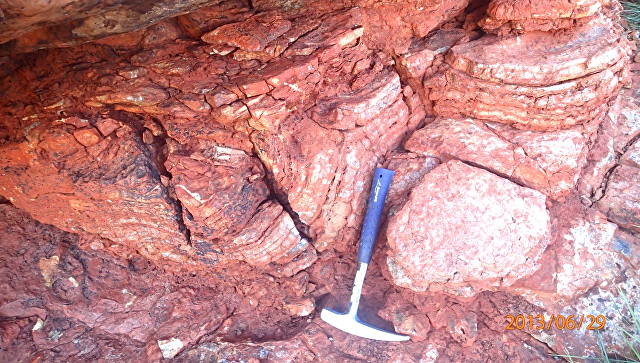
Species of the Dresser formation, where the traces of the ancient land life were found
MOSCOW, Dec 19 - RIA Novosti. Geologists have proven that fragments of graphite formed at the bottom of the primary ocean three and a half billion years ago represent traces of the existence of archaea - one of the two main types of microbes on Earth, reports the journal PNAS .
Armen Mulkidjanian, Professor of Biology from Moscow State University
Darwin's pond: Professor of Moscow State University explained why life was born on land
"Our measurements of the fraction of isotopes have shown that these fossils are unequivocally of biological origin.We do not have direct evidence that life could have existed already 4.3 billion years ago, but there is no reason to believe that this was impossible in principle, and we we plan to test this in the future, "- said John Wally of the University of Wisconsin in Madison (USA).

Earth before the beginning of time

The first organisms appeared on Earth during the Archaean era, but there is no generally accepted point of view about when and how it happened. So far there have been only a few fossil evidence that microbes existed in the primary ocean about 3.4 billion years ago, but many scientists believe that life could have originated much earlier.
In 2015, Japanese geologists who studied samples of graphite from the Isua formation, which was 3.7 billion years ago in the territory of Greenland, found hints of existence of life already at that time. The first unambiguous evidence for this was discovered last year, and a year earlier, scientists discovered in Australia that organisms existed on Earth even earlier - four billion years ago.
Many geologists, as Wally notes, fundamentally disagree with such estimates and believe that this happened much later - 2.5-3 billion years ago. They often criticize such finds, noting that deposits of graphite and other supposedly biogenic rocks could have formed without the participation of microbes, and traces of bacteria and archaea could draw the imagination of researchers.
The hollow of Danakil in Ethiopia
Geologists: life on Earth originated on land, not in the ocean
Wally and his colleagues tried to prove that skeptics are wrong. To do this, they studied the isotopic and chemical composition of graphite deposits found in Pilbara in western Australia three decades ago.
These deposits formed about 3.5 billion years ago in the shallow waters of the primary ocean, as evidenced by the rocks surrounding the graphite. They are distinguished by filamentary structures, similar to a multitude of microbes, "glued together" with each other.

"Talking" isotopes

Geologists drew attention to a well-known fact: living organisms and their remains are characterized by a slightly different proportion of carbon isotopes than for deposits of non-living organics. This makes it possible to unambiguously establish the origin of these or those sedimentary rocks.
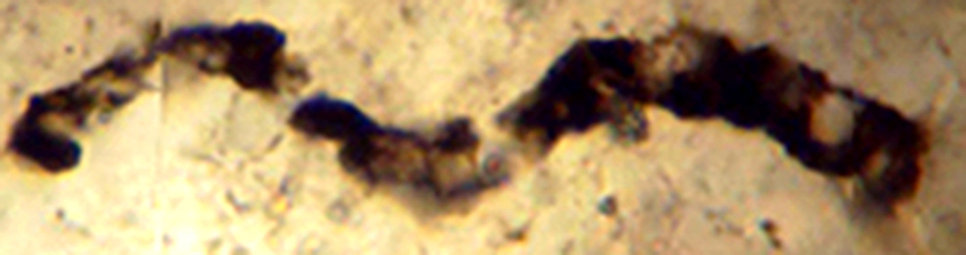
Remains of an ancient archaea found in western Australia
Guided by this idea, scientists cut off small layers of pieces of graphite found in Pilbara, and enlightened them with a particle accelerator. So they were able to accurately calculate the number of carbon atoms-12 and carbon-13 in supposed "bacteria" and surrounding matter of inorganic origin.
"The boundaries between microbes and inorganic deposits ideally coincided with the location of the zones with different proportions of carbon isotopes.If these structures are not of biogenic origin, such differences can not be explained.The proportions of carbon-13 and carbon-12 in these remains ideally correspond to that, how the metabolism of microbes proceeds and how they live as a whole, "- continues Wally.
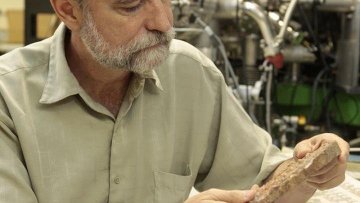
Mark Harrison studies a sample of Australian rocks
Scientists: life on Earth could have existed already 4 billion years ago
The same measurements, as the geologist notes, pointed out for the first time that scientists are dealing not with the first bacteria, but with archaea - distant relatives of modern staphylococci, Escherichia coli and other representatives of the microworld, which are slightly closer to multicellular creatures than other microbes. Moreover, the relatively low share of carbon-13 in the remains indicates that these microbes were fed with methane, which was then abundant in the atmosphere.
This discovery pushes back the appearance of the Archaean for nearly 800 million years - before scientists believed that they appeared much later than bacteria, about 2.7 billion years ago. So, says Wally, life evolved much faster than imagined, and could appear almost simultaneously with the birth of the planet.


Scientists have found out how drunk men perceive women

MOSCOW, Dec 21 - RIA Novosti. Men who have drunk alcoholic beverages tend to perceive women as partners for sex, according to scientists from the University of Nebraska-Lincoln in the United States. Their work is published by MedicalXpress .
Father and son.  Archive photo
Scientists have told how alcohol affects the ability to become a father
The study involved 50 men aged 20-30 years. Some of them drank alcoholic cocktails, the other used a placebo (an empty drink), after which they showed photographs of young women in evening dresses. Volunteers were asked to evaluate the attractiveness of women and make up a psychological portrait, while their eyes were watched by a special system.
Scientists have found that drunk men looked at women's breasts and waists longer than on their faces. The difference was more noticeable if women were described by most volunteers as "attractive" and "insecure".
Teens with alcohol
Scientists have revealed the connection between the mentality of the nation and alcoholism
At the same time, if a woman produced the impression of a "self-sufficient" and "spiritual" person, sober men devoted more time to studying facial features. Alcohol increased this difference - "drunken" volunteers almost did not consider the bodies of women who radiated confidence.
"A frank view of women leads to their dehumanization, which is the basis for many negative consequences, such as sexual violence and gender discrimination at work," said one of the authors of the work Abigaille Rimer, noting that such studies will help to combat such unpleasant manifestations.

what prevents you from accurately determining the age

MOSCOW, Dec 21 - RIA Novosti, Olga Kolentsova. To determine the age of organic remains, including human tissues and bones, archaeologists use the method of radiocarbon analysis. It allows you to very accurately date the find, because it is based on radioactive decay, nevertheless the method sometimes fails. 
Christian Orthodox light candles from the Holy Fire in the Church of the Holy Sepulcher.  Jerusalem, April 30, 2016
Archaeologists have calculated the exact age of the tomb of Christ in Jerusalem

Physical principles of radiocarbon analysis

In the bodies of animals and plants and in general in any biological organics the ratio of radioactive and stable carbon is always constant. This fact was used by the American scientist Willard Frank Libby to develop the method of radiocarbon age determination in the 1950s. In 1960, he received for this Nobel Prize in Chemistry. 
Universe
Astronomers have found carbon in the "childhood" of the universe
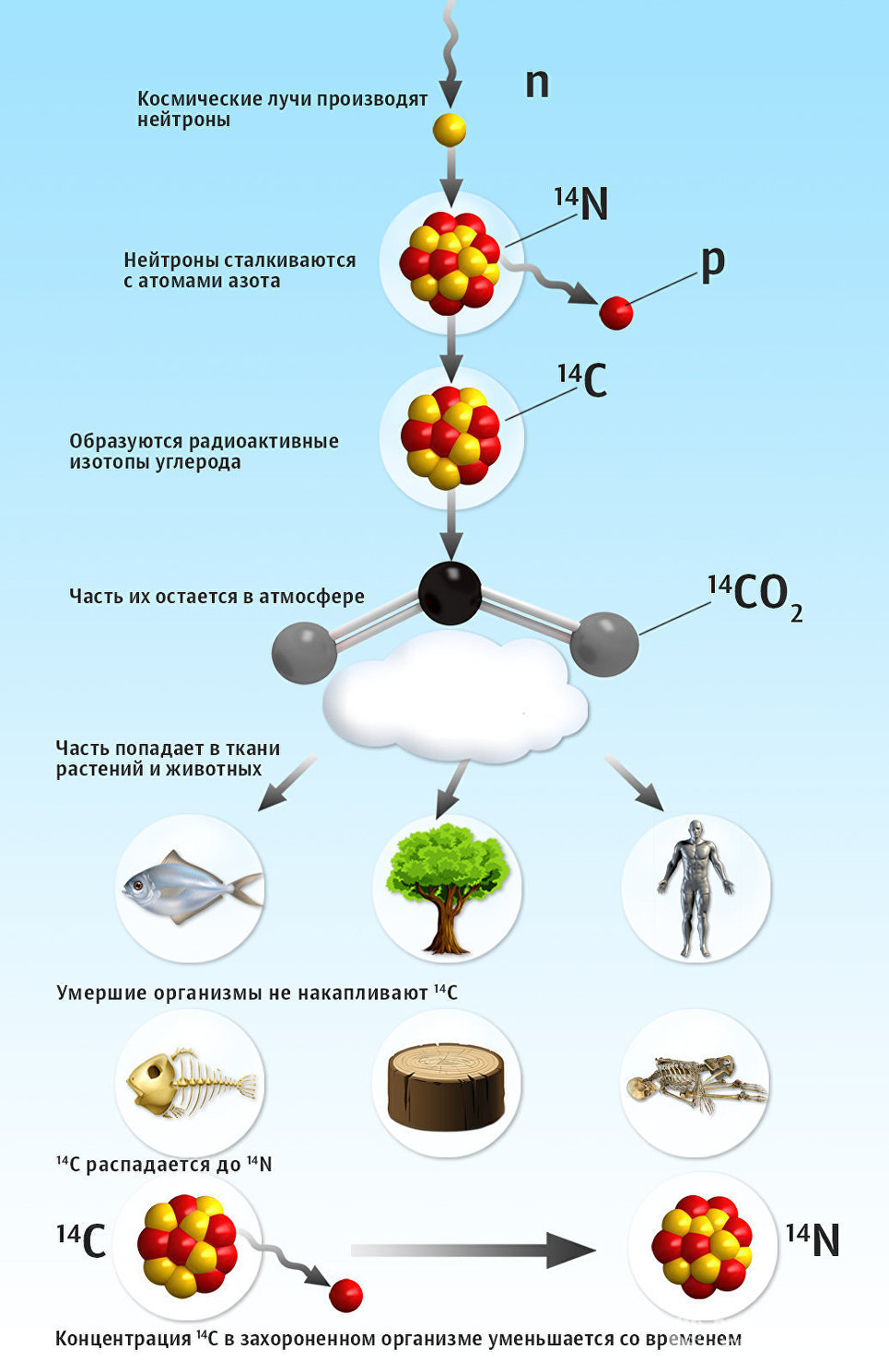
On Earth, carbon is represented by three isotopes - a variety of atoms, differing in the number of neutrons. Their ratio in the atmosphere is approximately the following:  12 C - 98.93%,  13 C - 1.07% and 14 C - 10 -12 %. The first two isotopes are stable, and the third is radioactive, that is, it is inclined to spontaneously change the composition or internal structure by emitting, for example, elementary particles. Isotope 14 C is constantly formed in the atmosphere of the Earth at an altitude of 11-50 kilometers as a result of bombardment of nitrogen by neutrons.
Radioactive isotopes are included in the circuit along with stable isotopes of carbon, which means that they enter the living organism with breathing or in the process of photosynthesis. While the animal or plant lives, the ratio of all three isotopes of carbon in it is maintained constant. After the death of the organism, exchange with the external environment ceases. At the same time, the amount of isotope 14 C decreases with time  , because it decays. 
The cycle of radioactive carbon in nature
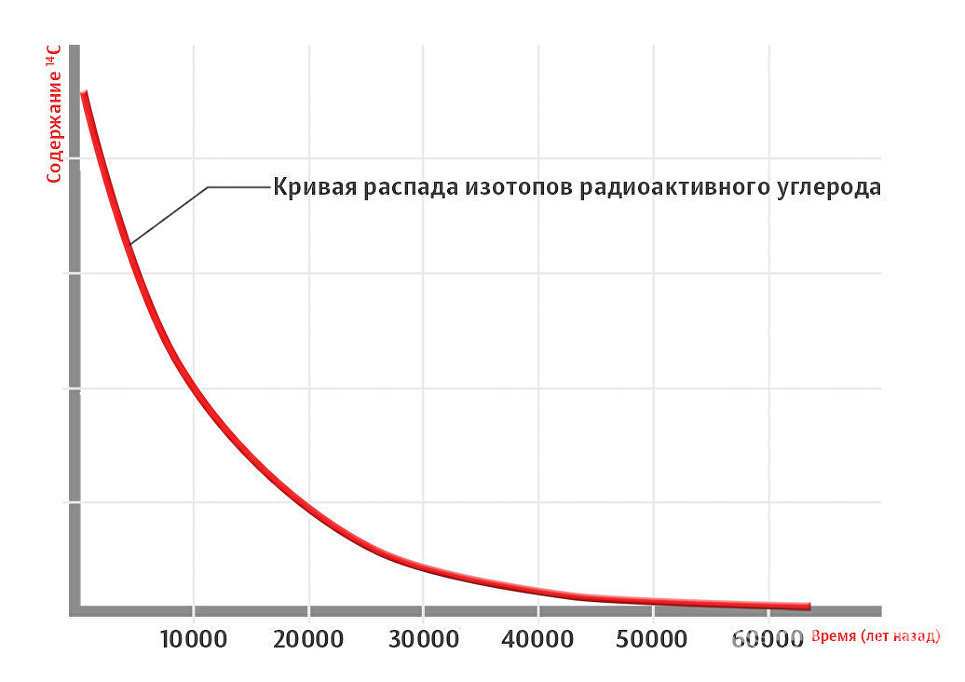
The radioactive decay of any element occurs at a constant rate. In particular, in 14 C, the half-life is about 5,730 years. Accordingly, by changing the proportion of the three isotopes of carbon, you can determine how much time has passed since the death of the plant or animal. Considering the exponential decrease in the amount of 14 C, the limiting age of the sample, which can be accurately determined by this method, is about 60 thousand years. Through this period of time, all the radioactive carbon disintegrates - and there is nothing more to count. It turns out that radiocarbon analysis is suitable for working with artifacts no older than the era of the Upper Paleolithic. 

The graph shows that for 60 thousand years all the radioactive carbon in the sample is broken up

Trust but check

There are a number of problems, because of which radiocarbon analysis gives an incorrect age. First, the proportion of carbon isotopes in the atmosphere has changed because of catastrophic natural phenomena: volcanic eruptions, meteorite and comet falls. It is changing even now under the influence of industrial carbon dioxide emissions. Secondly, 14 C can easily penetrate into the dead body from nearby objects, for example from the surrounding remains of layers of living plants, air or water, as well as volcanic sediments. 
A cat in the window of a house.  Archive
Products from wood "lock" carbon in themselves on average for 185 years
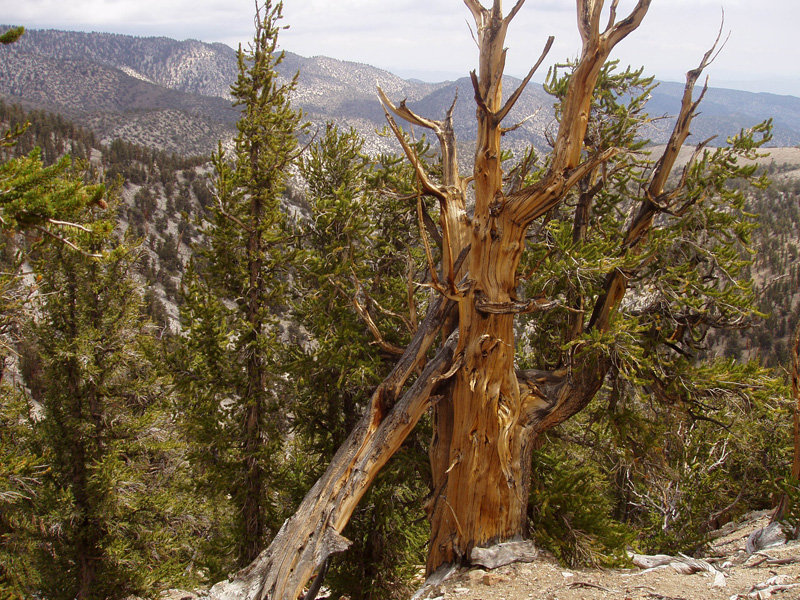
The calculation of the age of trees by the number of annual rings in different regions of the world helped to cope with the first problem. Scientists have studied the sections of awning pines in the south-west of the United States and oaks buried in the river and bog sediments of Europe. Small changes in the graph of fluctuations in the level of radioactive carbon were made by archaeological finds, the age of which was determined from written sources, for example, grains in a tomb with the date of burial. For older samples, the results of measurements of the 14 C content in corals, whose age was established by thorium-uranium method, were used. All of this as a whole made it possible to calibrate the 14 C schedule  in the atmosphere in time, and now the data obtained by radiocarbon analysis can easily be corrected simply in a computer program. 
A spruce pine aged 4847 years, defined by the number of tree rings
Errors of analysis associated with an additional  14 C, trapped in an already dead sample from outside, is much more difficult to fix. It is impossible to fully calculate the effect of all sources of radioactive isotopes on the object under study, so dating can fluctuate within ± 300 years. In many cases, especially when it comes to the prehistoric period, this is not so critical. It is doubtful when radiocarbon analysis showed quite some incredible age of the archaeological site.

ENERGY NEWS

Oil prices rally on geopolitical tensions April 10 (UPI) -- Geopolitical factors spilled over into the broader economic mood early ...