Thursday, December 21, 2017

Geologists have created a 3D model of the largest iron deposit in Russia

Computer model of Kovdorskoye field
MOSCOW, Dec 21 - RIA Novosti . Scientists from the Kola Science Center of the Russian Academy of Sciences have created a three-dimensional model of the Kovdor carbonatite complex, the largest iron, phosphorus and zirconium deposit in Russia, an article published in the journal Minerals says .
Ingots of gold
Russian scientists cheapened gold production almost twice
"Our work is not only fundamental, but also applied in nature, because it is the largest deposit, and the patterns of spatial distribution of mineral composition, grain size and other parameters revealed by us should be used for extraction, processing and enrichment of ores," said Grigory Ivanyuk from Kola Scientific Center of the Russian Academy of Sciences in Apatity.
One of the main problems for geologists, miners and industrialists is the assessment of how many minerals are contained in certain deposits. Today, scientists are trying to obtain such data in two ways - using costly "point" measurements at the field itself, and creating their computer models based on a relatively small number of samples from different parts of the rock strata and modern methods of computational mathematics and statistics.
Using this technique, Russian geologists created an accurate model of the Kovdorskoye deposit, one of the largest iron reserves and a number of other minerals on Earth, located in the west of the Murmansk region near the city of Kovdor.
In form it resembles a tube similar to kimberlite pipes with diamonds in Siberia and South Africa. The deposit is composed of rocks of magmatic origin, consisting of many minerals, including very rare ones, but olivine, magnetite, apatite and calcite predominate among them.
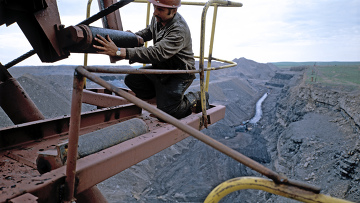
Kaa-Khem coal mine.  Archive
A large deposit of coal and methane is open in Chukotka
Three minerals are of industrial interest: magnetite, apatite and baddeleyite. Some of them go for processing in Russia, some - for abroad. Baddeleyite is used in the manufacture of all kinds of refractory substances and coatings for spacecraft, nuclear power, magnetite for iron, apatite for the production of phosphorus fertilizers and incendiary mixtures. All three minerals are mined in an open pit in one of the largest quarries in the Murmansk region.
"Carbonatite complexes are very rare objects, the study of which sheds light on the laws of the structure and evolution of the earth's crust, important for fundamental science.And the fact that a lot of remarkable minerals is associated with phosphorites and carbonatites attracts attention of specialists in practical geology" , The scientist continues.
To draw a map of this field, scientists have broken it into many blocks, only a small part of which was studied on the spot. In total, scientists extracted about 550 samples of rocks whose chemical and mineral composition helped them determine the contents of all the other blocks and understand how the Kovdorsky complex is arranged.
Oil production.  Archive photo
The scientist predicted the rapid discovery of new oil and gas fields in Siberia
As it turned out, the "tube" is heterogeneous inside, they consist of layers of different mineral composition. For example, near the edges of the tube there are deposits of relatively useless olivine, in the center there were deposits of spar, and between them - deposits of iron ore, magnetite.
Understanding this peculiarity of the deposit, as the geologist notes, will allow industrialists to plan the extraction of iron ore and many other minerals for many years to come and spend the minimum amount of funds for the extraction of iron and other metals from it.
As a kind of bonus, scientists discovered two previously unknown minerals. The first of these is a campelite, a combination of phosphorus, scandium, magnesium and barium, which was named after Felix Kampel, the former technical director of Kovdorsky GOK. The second is hydroxynatropyrochlor, a compound of chlorine, niobium, sodium, and calcium.

Scientists found out when people are most interested in sex

MOSCOW, Dec 21 - RIA Novosti . People are most interested in sex on New Year, Christmas and other holidays, scientists say in an article published in the journal Scientific Reports.
Young couple in bed
Scientists have uncovered the unusual nature of the connection between sex and aggression
"The emergence of the global network and social networks has given us an incredibly powerful tool for observing how the collective mood of people and their behavior change.We first studied the reproductive habits of people at the level of the entire planet, following the changing interest in sex among users of the network in different seasons, "- says Luis Rocha (Luis Rocha) from the University of Indiana (USA).
There is a general idea that the peak of fertility in most developed countries falls on August and September. Not only philistines, but also scientists believe that the reason for this is quite simple - and serious decisions that it's time to have a baby, and occasional pregnancies most often occur during New Year and Christmas holidays.
Some researchers believe that this anomaly is caused not by social but by biological factors associated with as yet unknown biorhythms and various natural and environmental phenomena - for example, with the level of sunlight or the length of the day, which also can influence people's behavior. In favor of this, according to scientists, says that the autumn outbreak of fertility is approximately the same in different countries, completely different in culture and social attitudes.
Rocha and his colleagues tried to check whether this was so, and drew attention to the main drawback of such studies - their authors studied the life of only the inhabitants of the northern hemisphere, where Christianity and European culture dominate.
Scientist with DNA model in vitro
Sex appeared due to viruses, scientists say
Scientists have tried to fill this gap, for which they analyzed how often users of social networks write about sex at different times of the year, and tried to find a link between bursts of interest in relations with the opposite sex and fertility. The research was based on several million messages on Twitter and requests that users left in popular search engines from January 2004 to February 2014.
As it turned out, holidays, sex and fertility peaks are really connected - in Christian countries the frequency of such requests increased in the area of ​​Christmas and New Year, and in Islamic states - after Uraza-Bairam. Almost nine months later, the birth rate began to rise sharply.
Father with children
Scientists: men really get fat after the birth of the first child
At the same time, scientists failed to find any significant differences in interest in sex and gender continuation between the inhabitants of the southern and northern hemisphere, which indicates that this phenomenon is not related to the climate, the position of the Earth in orbit and other natural factors. Most likely, he notes, Rocha, he is exclusively social in nature.
"Both Christmas and Uraza-Bairam can give rise to a special collective mood, which, apparently, is associated with an increased birth rate. Perhaps this is due to the fact that during these holidays adults often give gifts to children, which encourages them to think about the continuation of the family and makes us take our family and family matters more seriously, "Rocha concludes.

Scientists have told, what product slows down aging of a brain

MOSCOW, Dec 21 - RIA Novosti. Daily consumption of green salad can strengthen brain health and prevent the onset of senile dementia, according to Medical Xpress .
The structure of the neuron of the brain
The main reason for dementia is named
The study was conducted by scientists from the Medical Center of the University of Rush in Chicago. They analyzed the diet and the results of cognitive tests of 960 people. The average age of participants was 81 years, the observation period was ten years. For comparison, they were divided into five equal groups, depending on the frequency of consumption of greens - spinach, cabbage, lettuce.
In general, the test scores were reduced for all participants at a rate of 0.08 standard units per year. In this case, the brain of those who regularly eat salad (about 1.3 servings per day), grew by 0.05 points slower than those who almost did not use it (0.1 servings). According to the author of the study, Martha Claire Morris, the difference in annual terms was 11 years.
The researchers emphasize that the results of the study indicate a link between the consumption of greenery and a decrease in the rate of aging of the brain, but do not exclude the possibility that the effect can be achieved by influencing other factors, for example, whether a person smoked or not, how often he used alcohol and whether he did sports .

Season's micro-greetings: Scientists claim smallest Christmas card

(Reuters) - British scientists have created what they believe is the world’s smallest Christmas card, a seasonal greeting so tiny that over 200 million of them could fit into a standard postage stamp.
The card, created by the National Physical Laboratory (NPL), the U.K.’s national measurement standards laboratory, measures 15 x 20 micrometers. A micrometer is one millionth of a metre.
It is made from platinum-coated silicon nitride, and was illustrated using a focused ion beam. The card’s cover features an etching of a snowman, above the words “seasons greetings,” as well as a seasonal message inside.
One of the card’s inventors, NPL’s Dr David Cox, who created the card along with his colleague Dr Kin Mingard, said the technology used in its making had more practical uses.
“We are using the tools that created the card to accurately measure the thickness of extremely small features in materials, helping to unlock new battery and semiconductor technologies. It’s a genuinely exciting development.”
The NPL said that the previous smallest Christmas card measured 200 x 209 micrometers, making their effort over 100 times smaller

3D printed Buddhist statues displayed in east China

TAIYUAN, Dec. 17 (Xinhua) -- Thanks to 3D printing technology, three reproductions of Buddhist statues in the Yungang Grottoes, a 1,500-year-old UNESCO World Heritage site, are being displayed in the eastern coastal city of Qingdao.
The Yungang Grottoes art gallery, which opened to the public Saturday, displayed three full-size replicas of Buddhist statues from the caves in northern China's Shanxi Province.
The middle one stands 10 meters high, while those beside it are 6 meters high.
"It's hard to believe that they are reproduced. They look so real," said Zhang Zhuo, head of the Yungang Grottoes Research Institute.
The two-year program was jointly launched by Yungang Grottoes Research Institute, Qingdao Publishing Group and Zhejiang University.
Researchers built 3D models for the three statues, then used 3D printers to reproduce them.
"The color was first painted automatically by machines. Then artists from Yungang added color in detail," said Diao Changyu, assistant to the dean of the cultural heritage institute at Zhejiang University.
"It's amazing to see the Buddha figures of Yungang. I plan to visit the grottoes next year," said visitor Cai Meijiao.
The Yungang Buddhist Grottoes in Datong City boast 51,000 Buddhist images in caves stretching for 1 kilometer along a cliff. It was listed as a UNESCO World Cultural Heritage site in 2001.
According to Zhang, the reproduction programs of two other caves, supported by 3D printing technology, are underway.

Chinese scientists say penguins date back 14,600 years

BEIJING, Dec. 21 (Xinhua) -- A study by Chinese scientists in East Antarctica has shown that penguins existed in the region 14,600 years ago, 6,000 years earlier than previously thought.
The study was conducted by a research team from a laboratory co-founded by the State Oceanic Administration and the University of Science and Technology of China.
The research in the Vestfold Hills in East Antarctica found deglacial sediment dating back 15,600 years, and sediment of penguin excrement and dirt dating back 14,600 years. This shows that penguins immigrated there around 1,000 years after the ice sheet melted, and the population kept growing.
The results are important for research into the evolution of seabird breeding grounds in polar regions, the positioning of penguin shelters during the last deglaciation and penguin migration in Antarctica.

8,000 year old village site discovered in Inner Mongolia

HOHHOT, Dec. 21 (Xinhua) -- Archaeologists recently discovered ruins of an 8,000-year old village in Huade County, northern China's Inner Mongolia Autonomous Region.
The Simagou site covers an area of 30,000 square meters and consists of 13 round or rounded rectangular pit houses. More than 1,300 objects, mostly stone axes and stone shovels, were also unearthed.
"Most objects were chipped stone tools, meaning stoneware production was the main activity at that time. And the large quantity of animal bones and stoneware show that people made their living by hunting and collecting food," said Hu Xiaonong, head of the archaeological team.
Experts say the site has distinctive features of Yumin culture but is more advanced than similar relics discovered earlier.
Yumin culture, a civilization between the Paleolithic Age and Neolithic Age, was first found in 2014 in the middle part of Inner Mongolia.

ENERGY NEWS

Oil prices rally on geopolitical tensions April 10 (UPI) -- Geopolitical factors spilled over into the broader economic mood early ...